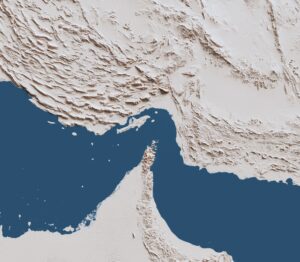

The Strait of Hormuz is one of the world’s most strategic trade routes, particularly for hydrocarbons. Episodes of tension there (attacks, threats of closure, sanctions, regional escalations) cause an immediate increase in uncertainty and volatility.
- But this uncertainty is not confined to the energy sector: it extends not only to the financial markets as a whole, but also to the real economy via inflation, transport costs and supply chains.
This dynamic is rooted in the law of the sea: commercial shipping takes place in a space governed by distinct legal statutes (notably the territorial sea, the exclusive economic zone (EEZ) and the high seas). Although the high seas are in principle open to international traffic, they do not eliminate geopolitical risks, which often materialize in areas close to coasts, straits and compulsory routes.
Straits used for international navigation are of great legal and economic importance, since they concentrate flows and make trade dependent on the safety of shipping lanes. So when a strategic crossing point becomes unstable, it’s not just a geopolitical event, but also a potential disruption to a maritime traffic area whose continuity is essential to world trade.
With this in mind, the agri-food sector, which has a reputation for being “defensive”, may also be affected, particularly by rising input costs (energy, fertilizers) and logistics (freight, insurance, lead times).
So the key question becomes: how does an event in the Strait of Hormuz affect the markets, and what strategies can reduce exposure to this volatility?
I The Strait of Hormuz: a trade hotspot and a generator of risk premiums
The Strait of Hormuz is a “bottleneck”: a narrow zone, difficult to bypass in the short term, through which very large volumes of goods, especially energy, transit. Its strategic value lies not only in its geographical extent, but also in its position: it connects major production zones with areas of global consumption.
So the mere possibility of a disruption is enough to worry the markets.
From a logistical point of view, sailing in a high-risk area also entails higher costs for marine insurance, security measures and sometimes diversions (longer routes), all of which increase the cost of transport. Even when maritime traffic continues as normal, the various players in the transport and trade sectors take the risk into account, which can lead to higher prices.
We can distinguish between localized incidents, explicit threats of blockades or military escalation, economic sanctions or trade restrictions that modify routes and volumes, and informational episodes (rumors, diplomatic signals) that move prices without any immediate physical shock.
This distinction is essential: there is a difference between actual disruption of flows (real supply shock) and an increase in perceived risk (confidence shock). Markets often react to the latter even before the former materializes, which explains the rapid and sometimes reversible movements.
The first observable reaction is generally a rise in volatility: traders adjust their expectations and hedge their bets. In commodities, this translates into a rise in the “geopolitical premium” built into oil prices. In financial markets, it provokes aflight-to-quality movement, leading investors to arbitrate in favor of assets deemed safer.
Indeed, a shock to Hormuz can influence not only oil prices, but also stock market sectors exposed to energy, the currencies of importing and exporting countries, and inflation expectations. In other words, Hormuz acts as a trigger for portfolio reallocation.
II Transmission to the oil market and financial assets: prices, volatility, inflation
On the oil market, an event in Hormuz acts first and foremost as a risk of supply shock: if flows are slowed down, the supply-demand balance becomes tighter and the price rises.
Even without an actual interruption, the threat is enough to drive prices up, as managers build in the probability of a rupture.
- In the short term, the reaction is often brutal: Brent prices rise, implicit volatility increases, and sometimes the structure of forward prices changes (nearby prices rise faster than distant prices if immediate tension is anticipated).
- In the medium term, the effect depends on the duration of the crisis and possible responses: mobilization of strategic stocks, adjustment of production by certain countries, partial substitution by other energy sources. But these adjustments are neither instantaneous nor unlimited, leaving a period when the market remains “nervous”.
The rise in oil prices is rarely an isolated shock: it is transmitted to production and transport costs, and then to inflation. This inflation can then influence monetary policy (higher interest rates or keeping them high), which weighs on certain financial assets.
The macroeconomic channel therefore links geopolitical tension, higher energy prices, inflation, interest rates/financial conditions and asset valuations.
Against this backdrop, equity markets may correct, especially if the energy shock is interpreted as negative for growth. Energy-consuming sectors (transport, heavy industry, chemicals, distribution) are seeing their margins squeezed, while energy producers may benefit from higher prices (albeit with increased political risk).
Beyond equities, a shock to Hormuz could influence not only bonds (impact on real and nominal rates), but also currencies and credit (indebted companies sensitive to energy costs).
This shows that the impact on the market “in general” is first and foremost a question of risk reassessment and regime change (more volatility, higher risk premiums), and not just a question of oil.
III Impact on the agrifood industry: inputs, logistics, food prices and margins
The agri-food sector is heavily dependent on energy. On the one hand, agriculture uses fuel for machinery, internal transport and irrigation. On the other, the food industry consumes energy for processing, packaging, preservation (cold chain) and distribution.
A sustained rise in oil prices will therefore increase these costs.
A crucial point is that of fertilizers, whose cost is linked to energy (particularly natural gas). If a geopolitical shock causes a general rise in energy costs, fertilizers can become more expensive, which has repercussions on agricultural production costs, then on the prices of agricultural raw materials and, ultimately, on certain food prices.
The food industry is also vulnerable to international logistics. A risky maritime zone often means: higher insurance premiums, additional delays, higher freight costs… this is particularly important for goods with long supply chains, for perishable products, or for countries that import a significant proportion of their food and agricultural input requirements.
- So, even if Hormuz is not an “agri-food” strait, it can affect the sector through higher transport and energy costs.
At company level, the challenge becomes the ability to absorb or pass on rising costs, or ” pricing power “. Some food companies can protect their margins thanks to strong brands or relatively inelastic demand, while others, more exposed to price competition, may suffer more.
For agricultural raw materials, the effect can be indirect but real: if input and transport costs rise, agricultural price volatility can increase. The agri-food sector is therefore not systematically a “safe haven”: it can be defensive in terms of demand, but fragile in terms of costs.
IV Strategies to reduce Hormuz risk
The idea is to avoid losses due to a general market downturn (equity risk), inflation (erosion of the purchasing power of real returns), rising costs (energy-sensitive companies), excessive volatility (timing risk).
- Indeed, the priority is to hedge against volatility over the medium to long term.
Tensions in a strategic strait affect the economy through a very important channel: dependence on hydrocarbons (price and supply). The alternatives are therefore to focus, in a sectoral analysis, on economic models that consume less fossil energy, substitute domestic energy for imported energy, and shorten supply chains.
- Renewable energies (solar, wind, hydro) rely on local resources, and therefore reduce exposure to geopolitical shocks on oil routes. In the short term, they do not cancel out dependence (intermittency, grid needs), but they change the risk profile of the energy system in the medium to long term.
It is also possible to replace fossil fuels (transport, heating, certain processes) with electricity in order to reduce transmission, a process known as electrification.
One of the strategies for reducing dependency is energy efficiency (sobriety, renovation, industrial optimization), the most immediate alternative since it is based on reducing consumption.
These solutions reduce the impact of peaks and prices and make the integration of renewables more stable, thereby indirectly helping to reduce sensitivity to an oil crisis.
Other transport and logistics alternatives are based on diversifying routes and suppliers, because vulnerability comes from concentration. One resilience strategy is to multiply options: raw material suppliers, logistics hubs, shipping routes, contracts, etc. Relocation, or even nearshoring , can shorten the chain and thus reduce exposure to straits and freight/insurance costs.
From a resilience point of view, we can propose a “double lever” approach linking phosphate and nuclear power: on the one hand, to secure agricultural production through strategic management of phosphorus (an important input), and on the other, to reduce macroeconomic vulnerability to oil shocks by relying on largely decarbonized and controllable electricity. The link between phosphate and nuclear power is indirect but real: some phosphate rocks naturally contain traces of uranium (and sometimes thorium), which has led to the consideration or practice, in certain industrial contexts, of recovering uranium as a by-product during processing. This possibility illustrates the idea of integrated resource development and supply diversification.
The importance of nuclear power in the analysis of the Strait of Hormuz lies in its systemic role. By providing stable, low-carbon domestic electricity production, nuclear power is helping to electrify numerous sectors such as transport, heating, industry and the agri-food cold chain.
Consequently, the combination of a more secure supply of agricultural inputs, thanks in particular to phosphates and circular resource management, and an energy mix less dependent on imported hydrocarbons, of which nuclear power can be an essential pillar, will help reduce structural dependence on the main strategic oil trading points.
In addition, technological progress and the emergence of private players in the space sector are leading us to envisage new perspectives: projects linked to the exploitation of extraterrestrial resources (metals present on certain asteroids or materials available on the Moon), are raising major questions. Although the 1967 Space Treaty prohibits the national appropriation of celestial bodies, there are still debates as to the regime applicable to the resources that could be extracted, while the Artemis Agreements demonstrate a real desire to regulate these activities.
If tomorrow’s economies were able to produce part of their energy or raw materials from space-based resources, would we see a gradual reduction in dependence on strategic terrestrial gateways, or would this lead to a shift in dependency relationships towards new dominant players, or to geopolitical rivalries simply shifting to a new area of competition?
Photo by Planet Volumes on Unsplash
Sources :
United Nations Convention on the Law of the Sea, https://www.un.org/depts/los/convention_agreements/texts/unclos/unclos_e.pdf
“New pipelines will bring significant volumes of natural gas to new LNG export terminals”, U.S. Energy Information Administration, 2023, https://www.eia.gov/todayinenergy/detail.php?id=61062
“Commodity Markets Outlook World Bank, https://www.worldbank.org/en/research/commodity-markets
“Review of Maritime Transport 2024, United Nations Conference on Trade and Development (UNCTAD), 2024, https://unctad.org/publication/review-maritime-transport-2024
“Nuclear Power and Secure Energy Transitions, International Energy Agency (IEA), 2022, https://www.iea.org/reports/nuclear-power-and-secure-energy-transitions
“Uranium Production”, International Atomic Energy Agency (IAEA), https://www.iaea.org/topics/uranium-production
Artemis Accords, Cambridge University Press, International Legal Materials, https://www.cambridge.org/core/journals/international-legal-materials/article/artemis-accords/5874DB518591888E52CF2B816E4593F0
Artemis Accords, National Aeronautics and Space Administration (NASA), https://www.nasa.gov/artemis-accords/
“Solar cells made of Moon dust could power up a lunar base”, Nature, 2025, https://www.nature.com/articles/d41586-025-00971-x
“The Artemis Moon base project is legally dubious”, The Verge, 2026, https://www.theverge.com/science/905406/artemis-ii-moon-base-law
“How Rising Geopolitical Risks Weigh on Asset Prices, International Monetary Fund (IMF), 2025, https://www.imf.org/en/blogs/articles/2025/04/14/how-rising-geopolitical-risks-weigh-on-asset-prices